Monday, April 2, 2018

Recounting the Anthrax Attacks


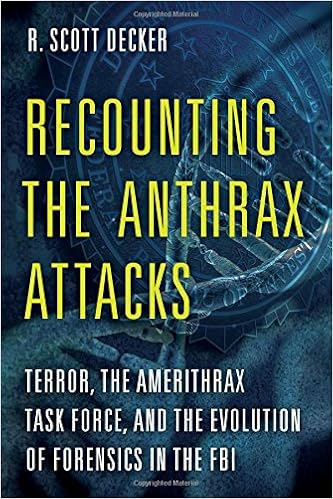
On April 8, 2018, a new book about the anthrax attacks of 2001 will be available in book stores.  The book is "Recounting the Anthrax Attacks" by R. Scott Decker.  While there have been a number of other books about the case, this is the first book written by an insider.  Scott Decker was in charge of the scientific investigation that led to identifying Bruce Edwards Ivins as the anthrax killer.  He's retired from the FBI now, so he is free to write about the case.

Although Scott and I have never actually met in person, we have talked on the phone and from December of 2015 to March of 2016 I helped him proof-read his book as he was writing it.  He used my web-site as a source for many documents related to the case.  I also remember sending him a CD with several FBI files I had obtained via the Freedom of Information Act (FOIA).  Since he was retired, it was easier to get the documents from me than to try to get copies from the original sources.

In December of 2017, I learned that on the first page of the Acknowledgements section at the beginning of the book Scott wrote:
There are many people who supported and encouraged me throughout this writing project. Edward Lake, who by keeping his Internet site up to date from the fall of 2001 through the end of 2014, chronicled the investigation. The site is a wealth of information and source of media references. I thank him for agreeing to review my manuscript for accuracy; any mistakes still remaining are completely on me. 

So, I'm looking forward to seeing what reaction the book receives.  It's been a long time since the case was closed.  But, there still seem to be countless conspiracy theorists and True Believers around the world who feel someone other than Ivins was the anthrax killer.  The blog you are reading was created to discuss the beliefs of those True Believers and conspiracy theorists.  Long ago I created this cartoon to illustrate the situation:


None of those conspiracy theorists and True Believers have any solid evidence to support their beliefs.  What they have instead is an absurd argument that no one can prove it is "impossible" for them to be right, and that somehow means they are right.

Hopefully, Scott Decker's book will re-open some discussions about the case, since it shows how the evidence against Ivins was uncovered and how Ivins repeatedly tried to obstruct the investigation.  It won't stop the True Believers or conspiracy theorists, but it might help isolate them from the rest of the world.

And, of course, since I'm mentioned in the book and my web site is used as a reference source on several occasions, plus he mentions both of my books about the case, it would be nice if his book spurs some sales for my book(s). 

There also seems to be a good chance that they might make a TV documentary series or a major motion picture out of Scott's book.  An agent even put together a video promoting the idea.


I have been totally involved in other subjects for years, so this renewal of interest in the anthrax case is also likely to be a source of interruptions for me.  But, I'll deal with it. 

I wish Scott the best of luck with the book.

Ed 

Wednesday, April 8, 2015

Subject: Richard Lambert's Lawsuit

The lawsuit former FBI agent Richard Lambert filed against the FBI, the DOJ and against other parties contains some very strong accusations that will almost certainly have Anthrax Truthers jumping for joy.  Mr. Lambert implies in the lawsuit that the FBI and DOJ are withholding "exculpatory evidence" which would disprove their case against Dr. Bruce Ivins in the anthrax letter killings of 2001.

Of course, Mr. Lambert was the leading FBI agent pointing the finger at Dr. Steven Hatfill during the time he was in charge of the Amerithrax investigation (from April 2003 to August 2006).  In August 2006, he left Amerithrax to take the position of Agent in Charge of the Knoxville, TN, office of the FBI.  Mr. Lambert's replacement on Amerithrax, Edward Montooth, examined the evidence found so far and concluded that Dr. Bruce Ivins was the person most likely to have sent the anthrax letters.  So, the focus of the Amerithrax investigation shifted from Dr. Hatfill to Dr. Ivins.

Based upon what I read in his lawsuit, however, leaving Amerithrax was a bitter pill for Mr. Lambert to swallow.  He repeatedly complains that he wasn't given the support he needed to find evidence against the person he believes sent the anthrax letters, and  he evidently believes that the "truth" about who sent the anthrax letters is being hidden from the American people. 

This of course, qualifies Mr. Lambert to join the ranks of "Anthrax Truthers."

Like all Anthrax Truthers, Mr. Lambert provides no facts or evidence to prove his case.  He basically argues that he wasn't allowed to find the "truth."  And, like all Anthrax Truthers, he wants the FBI and DOJ to prove the negative, i.e., to prove that there is NO "exculpatory evidence" showing Dr. Ivins to be innocent, and that further investigation will NOT find that someone else sent the letters. 

Here are some key parts of the lawsuit that relate to Amerithrax:   
52. In October 2002, in the wake of surging media criticism, White House impatience with a seeming lack of investigative progress by WFO, and a concerned Congress that was considering revoking the FBI’s charter to investigate terrorism cases, Defendant FBI Director Mueller reassigned Plaintiff from the FBI’s San Diego Field Office to the Inspection Division at FBI Headquarters and placed Plaintiff in charge of the AMERITHRAX case as an “Inspector.” While leading the investigation for the next four years, Plaintiff’s efforts to advance the case met with intransigence from WFO’s executive management, apathy and error from the FBI Laboratory, politically motivated communication embargos from FBI Headquarters, and yet another preceding and equally erroneous legal opinion from Defendant Kelley – all of which greatly obstructed and impeded the investigation.
and
53. On July 6, 2006, Plaintiff provided a whistleblower report of mismanagement to the FBI’s Deputy Director pursuant to Title 5, United States Code, Section 2303. Reports of mismanagement conveyed in writing and orally included: .......
(j) the FBI’s fingering of Bruce Ivins as the anthrax mailer; and, (k) the FBI’s subsequent efforts to railroad the prosecution of Ivins in the face of daunting exculpatory evidence. Following the announcement of its circumstantial case against Ivins, Defendants DOJ and FBI crafted an elaborate perception management campaign to bolster their assertion of Ivins’ guilt. These efforts included press conferences and highly selective evidentiary presentations which were replete with material omissions. 
and
55. After leaving the AMERITHRAX investigation in 2006, Plaintiff continued to publicly opine that the quantum of circumstantial evidence against Bruce Ivins was not adequate to satisfy the proof-beyond-a-reasonable doubt threshold required to secure a criminal conviction in federal court. Plaintiff continued to advocate that while Bruce Ivins may have been the anthrax mailer, there is a wealth of exculpatory evidence to the contrary which the FBI continues to conceal from Congress and the American people. The FBI vehemently opposes Plaintiff’s position. 
Note that in the above paragraph (#55), Mr. Lambert says that he (the "plaintiff") advocated "that while Bruce Ivins MAY have been the anthrax mailer," there is supposedly "a wealth of exculpatory evidence to the contrary," which would show that Dr. Ivins was NOT the anthrax killer.  So, Mr. Lambert is avoiding saying that Dr. Ivins was innocent.  He just claims that there is evidence which he believes should prove it.
 
You can also click on the images at the top of this thread to see larger versions of key pages, or you can click HERE to view the entire lawsuit claim.

Ed

Wednesday, March 11, 2015

Subject: Handwriting evidence

R. Rowley continuously argues his mistaken beliefs about handwriting evidence over and over and over.   Click HERE for his latest argument, which went as follows:
Mister Lake ignores the findings of the Task Force's own questioned document examiner and continually touts unnamed 'witnesses' (ie informants) whose testimony would be excluded for reasons adduced dozens of times in the past 3 or 4 years. To 'prove' (huh?) that Ivins' 'disguised' printing bears some resemblance (on how many points? No clue!) to the Amerithrax letters.
Here is Rule of Evidence #701:
  -------------------------
RULE 701:
Opinion Testimony by Lay Witnesses

If a witness is not testifying as an expert, testimony in the form of an opinion is limited to one that is:

(a) rationally based on the witness’s perception;

(b) helpful to clearly understanding the witness’s testimony or to determining a fact in issue; and

(c) not based on scientific, technical, or other specialized knowledge within the scope of Rule 702.

-------------------------------
Mara Linscott, Patricia Fellows and possibly Nancy Haigwood would have testified as LAY WITNESSES that the handwriting on the anthrax documents - in their opinion - resembled Dr. Ivins disguised handwriting.  Here is what it says on pages 89 and 90 of the Amerithrax Investigative Summary about their planned testimony:
a witness who had received a number of packages and cards over the course of several years in the late 1990s and early 2000s was shown copies of the letters and envelopes used in the anthrax attacks. The witness thought that the handwriting on the envelope addressed to Senator Daschle reminded the witness of Dr. Ivins’s writing. If the witness were to receive a package with that writing on it, the witness would think of Dr. Ivins. The witness noted that, in particular, the style of the block letters with alternating heights stood out, as did the slant of the writing. The witness said that this was the type of writing Dr. Ivins used when he disguised his handwriting as part of a joke. As the witness studied the letters, the witness noted that the “E” and the “R” in the letter to the New York Post also looked familiar. The witness stated that these letters also reminded the witness of when Dr. Ivins disguised his handwriting as a joke. The witness described this “disguised” handwriting as being similar to Dr. Ivins’s standard handwriting, and that one could tell that he was trying to disguise his handwriting to a limited extent. Another witness familiar with the handwriting of Dr. Ivins in many contexts said the same thing.
The witnesses would have testified to this in court, under Rule #701.

1. They would NOT be testifying as experts.
2. Their testimony would be rationally based on their perceptions.
3. Their testimony would be deemed helpful in determining who wrote the letters.
4. Their testimony would NOT be covered by Rule 702.

Mr. Rowley inexplicably believes that such witnesses would have to be handwriting experts or they would not be allowed to testify about handwriting.  Click HERE for his latest post on this subject.  Rule #701 clearly says the lay witnesses the prosecution planned to use in the Amerithrax case CANNOT be such experts.  If they were such experts, they would have to testify under Rule #702, which covers "expert testimony."

When shown testimony about how handwriting testimony from lay witnesses was used in other cases, Mr. Rowley just argued that the circumstances were different.  In other words, he creates imaginary new rules to fit this case.  He seemingly cannot understand that Rule #701 covers lay witness opinion testimony in EVERY criminal case, not just cases which fit or don't fit his beliefs.

Plus, Mr. Rowley argues that an expert "document examiner" would testify in court, even though the prosecution would have NO REASON to call a handwriting "expert" who appears to have nothing relevant to say about Dr. Ivins' disguised handwriting or anything else proving Dr. Ivins' guilt. 

This purpose of this thread is to show Mr. Rowley once and for all time that his beliefs about handwriting evidence are NONSENSERule #701 CLEARLY says that lay witnesses CAN provide opinion testimony about handwriting they perceive as being familiar and relevant to the case.  Mr. Rowley had NO BASIS for arguing otherwise, yet he endlessly continues to do so.

Ed

Thursday, January 15, 2015

Subject: An "Opinion" vs a "Finding"


In a previous thread HERE, R. Rowley provided this interesting argument:
What do you think a jury's verdict is but a collective OPINION on the validity and weight of constellations of facts/evidence (including testimony) touching on a criminal case?!?!?!?!?!?!?
A jury's verdict, of course, is NOT a "collective opinion."  It is a FINDING.  The jury selection process is an attempt to get rid of any potential jurors who might have opinions about the case before they are admitted to the jury. During the trial, the jury first listens to the prosecution present their evidence intended to show that the defendant is guilty of the crime for which he or she is charged, and then the defense presents their arguments intended to show that the evidence presented by the prosecution is not conclusive.  The jury is supposed to listen to both sides of the argument, then they go into a room where they are supposed to discuss the evidence to reach an agreed upon "finding" as to whether the prosecution's case was proven or not proven.  If they cannot unanimously agree one way or the other, then the process starts all over again with a new trial.

Also interestingly, R. Rowley argued this:
What do you think the Henry Fonda character was trying to do in TWELVE ANGRY MEN but change the opinions of those 11 other jurors?!?!?!?
The screenplay for "12 Angry Men" is on-line HERE, and it shows that all the Henry Fonda character ("Juror No. 8") wants to do was what they are supposed to do in the jury room: discuss the case and the evidence.

And, gradually, that is what they start to do.

In concept, all the jurors can still have the opinion that the defendant is guilty and yet agree that the prosecution's case is "not proven."  If all the jurors feel that way, the "finding" or "verdict" must be "Not guilty due to insufficient evidence." In doing so, they do NOT decide that the defendant is "innocent."  They merely decide that there is "reasonable doubt" about his guilt.

The jury deliberation process is intended to settle all misunderstandings.  If a juror explains why he thinks the evidence says the defendant is guilty or not proven guilty, the other jurors will supposedly explain how they view the same evidence differently.  Gradually, though explaining how they view the evidence, they are all supposed to agree on the "correct" way to view the evidence.

In "12 Angry Men," for example, some jurors saw the eye-witness testimony as being conclusive.  But then someone pointed out that the eye witness saw the crime from her bed in the middle of the night.  And then his conversation takes place between the jurors:
FOREMAN: Wait a minute! Did she wear glasses at all? I don't remember.
NO. 11: (excited). Of course she did! The woman wore bifocals. I remember this very clearly. They looked quite strong.
NO. 9: That's right. Bifocals. She never took them off.
NO. 4: She did wear glasses. Funny. I never thought of it.
NO. 8: Listen, she wasn't wearing them in bed. That's for sure. She testified that in the midst of her tossing and turning she rolled over and looked casually out the window. The murder was taking place as she looked out, and the lights went out a split second later. She couldn't have had time to put on her glasses. Now maybe she honestly thought she saw the boy kill his father. I say that she saw only a blur.
NO. 3: How do you know what she saw? Maybe she's far-sighted.
[He looks around. No one answers.]
NO. 3: (loudly). How does he know all these things?
[There is silence.]
NO. 8: Does anyone think there still is not a reasonable doubt?    
Minds were changed by looking at the evidence.  However, no one argued that the defendant was "innocent."  All they did by discussing the evidence was determine that the prosecution's case was not sufficient to eliminate "reasonable doubt."  The final verdict was "Not guilty due to insufficient evidence."

The people who argue that they do not believe Bruce Ivins was the anthrax killer refuse to discuss the evidence with people who feel the evidence says Ivins was the killer.  I've been trying to get them to discuss the evidence for years, but to no avail.  They even state that there is "no evidence" to discuss.  It appears that, by denying the very existence of evidence showing Ivins to be guilty, they feel they can never be put in a position of having to discuss the evidence.  And if they don't discuss the evidence, they can never be shown to be wrong in their beliefs.

When R. Rowley is show to be wrong on other matters, like the law or the definition of words, he becomes "hypercorrective" and endlessly argues that his interpretation is the only correct interpretation. 

When DXer is shown to be wrong about other matters, he argues that I am not an official "expert" on the subject, and therefore my view is of no value no matter how much evidence I may have.  When experts disagree with him, he finds something in their background to dismiss their views (right or wrong) as worthless.  He argues that presenting facts and evidence is no different from arguing what is "possible."  Nothing but what DXer believes means anything to him. 

Ed


Monday, January 5, 2015

Subject: Facts vs Evidence


 Albert Einstein famously said,

“You do not really understand something unless you can explain it to your grandmother” [and get her to understand it, too.]

So, I'm going to try to explain the difference between "facts" and "evidence" to see if I understand it myself.

Evidence is presented in court to determine what the facts are, i.e., evidence is presented to let a jury decide if it is "a proven fact" that the defendant committed the crime for which he/she is accused.

Another source expresses this differently:
"Fact is a truth that can be proven. On the other hand evidence is something that is told by someone. It has to be accepted only on belief. There cannot be truth in all evidences.   This is the main difference between facts and evidence."
The copy of "The People's Law Dictionary" in my personal library contains these definitions:
FACT: n.  an actual thing or happening, which must be proved at trial by presentation of evidence and which is evaluated by the finder or fact (a jury in a jury trial, or by the judge if he/she sits without a jury).

EVIDENCE: n.   every type of proof legally presented at trial (allowed by the judge) which is intended to convince the judge and/or jury of alleged facts material to the case.  It can include oral testimony of witnesses, including experts on technical matters, documents, public records, objects, photographs, and depositions (testimony under oath taken before the trial).  It also includes so-called "circumstantial evidence" which is intended to create belief by showing surrounding circumstances which logically lead to a conclusion of fact.
So, it is totally absurd to say there is "no evidence" showing that Dr. Bruce Ivins was responsible for the anthrax attacks of 2001.  In the Amerithrax Investigative Summary report, the Department of Justice presented 92 pages summarizing the evidence against Dr. Ivins.  And they released thousands of pages of supplemental information.

A naysayer could argue that he or she does not accept or believe the evidence, and therefore, as far as they are concerned, it is not a proven fact that Dr. Ivins was the anthrax killer.  But, they cannot logically say there is "no evidence" showing Dr. Ivins was the anthrax killer.

In court the prosecutor would present the evidence that Dr. Ivins had means, motive and opportunity to commit the crime.  The prosecutor would establish "as a fact" that Ivins had means, motive and opportunity.  And the prosecutor would ask the jury to conclude and confirm the fact that Ivins was the anthrax killer.

On the Internet, an Anthrax Truther can present "evidence" showing that his or her favorite suspect was actually the real anthrax killer.

However, as it says above (and below), "There cannot be truth in all evidences.   This is the main difference between facts and evidence."

One Anthrax Truther on this blog presents "evidence" arguing that "linguistics" within the anthrax documents show that his unnamed "suspect" is the anthrax killer.  He indicates that someday he may present "evidence" showing that his "suspect" had means, motive and opportunity.  But, for now, all he is willing to discuss is the "linguistics" in the documents.  As I see it, his linguistics "evidence" is easily challenged and disputed, so there is no "truth" in his "evidence."  It's something only he sees.

Another Anthrax Truther argues that a 2003 news report saying that Adnan el-Shukrijumah had gone to the United States via Mexico is "evidence" that el-Shukrijumah mailed the anthrax letters.  As further "evidence," he cites another news story which said el-Shukrijumah entered the U.S. "some time after September 1, 2001" as evidence that el-Shukrijumah was in New Jersey in September and October of 2001 mailing the anthrax letters.   As I see it, his "evidence" is so vague and lacking in detail that is no way to find any "truth" in his "evidence."  "The truth" is something only he sees in his "evidence."

The Department of Justice's case against Dr. Ivins, on the other hand, provides excellent evidence which shows that Ivins had means, motive and opportunity to commit the crime, plus they can have FBI agents testify that all other likely suspects can be eliminated for lack of means, motive and/or opportunity.

Unlike the two Anthrax Truthers mentioned above, the DOJ can show solid evidence to establish as a fact that Ivins had the means to commit the crime.   The DOJ can present scientists who can explain that they personally created powders identical to the attack powders using the same equipment Ivins had available in his lab.  The DOJ can also show that Ivins had the opportunity to commit the crime.  To establish that as a fact, they can present documents, time logs and testimony showing that Ivins had no alibi for the times when the mailings were done.  And the DOJ can show that Dr. Ivins had motive for committing the crime:  Though his emails and the testimony of witnesses, they can establish as a fact that:  (1) Dr. Ivins’s life’s work appeared destined for failure, absent an unexpected event.  (2) Dr. Ivins was being subjected to increasing public criticism for his work.  (3)  Dr. Ivins was feeling abandoned in his personal life.  A jury could reasonably conclude that Ivins expected the anthrax mailings to make him and his work important again.

The jury would watch and listen to the evidence being presented.  They would then listen and watch the defense present evidence for their side of the argument.  When done, the jury would decide, based upon all the evidence presented to them, if the case against Dr. Ivins was proven or not proven.  If they decided it was proven, it would become a "fact" that Dr. Ivins was the anthrax killer.

Others can disagree with the "fact" that Ivins did it, but their disagreements would be of no value unless and until they could somehow present better evidence showing someone else did it.

That's my explanation of the difference between "facts" and "evidence."


Below are some sources I used in writing the comment above.
----------------------------------------

Facts and evidence are two words that are often used incorrectly. Even though they are often used interchangeably, they have entirely different meanings. A fact is something that can be proven but evidence is something that someone tells you or objects that can point to the facts. Evidence can be accepted only as a belief that something is a fact and in all cases this is not true.

There are two types of evidence – factual evidence and documented evidence.  In a trial, the court always relies on the documented evidence because facts are needed to prove that it is not true.
However, it is very easy to damage or destroy evidence. Therefore there is not a lot of strength in evidence and it is difficult to authenticate it. In contrast to evidence, a fact can be proven by any means and this is one of the main differences between the two words.

A fact cannot be destroyed or damaged. This is true of scientific facts that have been proven by multiple experiments. No matter how much you change the variables, the conclusion is fact. Facts are based on evidence, but evidence does not necessarily have to be true. It is also considered to be a reality about which a large number of people agree. Facts cannot be disputed.

Information that proves to be helpful in forming a conclusion is termed evidence, but it has to be either true or false. Evidence can be disputed, which is why it is presented in court. The lawyers for both sides present arguments and witnesses to prove or disprove the evidence that has been collected for the case.

It is the evidence that starts an investigation and fact develops from the conclusion of the investigation.

Click HERE for the source.

-------------------------------------

Facts and Evidence are two legal terms that are used with difference. They are generally understood as one and the same thing to an untrained litigant, but strictly speaking they are different.

Fact is a truth that can be proven. On the other hand evidence is something that is told by someone. It has to be accepted only on belief. There cannot be truth in all evidences. This is the main difference between facts and evidence.

Evidence is generally of two types, namely, documental evidence and factual evidence. The decision of the court is always based on documental evidence. You need to have factual evidence to disprove it.

On the main difference between facts and evidence is that evidence can be easily destroyed. This is because of the fact that evidence lacks strength and cannot be proved authentically. On the other hand a fact can be proved by all means. In fact the proven status has made the fact different from evidence.
On the other hand a fact cannot be destroyed at all for that matter. Scientific facts are all proved and hence can never be destroyed by any means. This is mainly due to the fact that fact is characterized by truth whereas evidence is characterized by falsehood.

Evidence is information helpful in forming judgment or a conclusion. Remember it is only information that can be either true or false. On the other hand a fact is a fundamental reality that has been agreed upon by a substantial strength of people.

Another important difference between facts and evidence is that facts cannot be disputed. On the other hand evidence can be disputed in the court. It all depends on the skill of the lawyer to dispute the evidence produced in the court. Fact is arrived at after investigation or experiment. Evidence begins an investigation.

Click HERE for the source. 

--------------------------------------------------------

fact

An objective consensus on a fundamental reality that has been agreed upon by a substantial number of people.

http://en.wiktionary.org/wiki/fact?rdfro...

evidence

information used to establish facts in an investigation

http://www.askoxford.com/concise_oed/evi...

information helpful in forming a conclusion or judgment

http://education.yahoo.com/reference/dic...

one or more reasons for believing that something is or is not true

http://dictionary.cambridge.org/define.a...

Fact is that which is accepted by a large number of persons. Evidence is information provided by a few persons for accepting a certain fact.

Some evidences may become disputable at a later date. That which is never disputed becomes a fact.

http://www.trueauthority.com/cryptozoolo...

Click HERE for the source.  

Ed

Wednesday, November 12, 2014

Explaining What You Understand


Albert Einstein said, "You do not really understand something unless you can explain it to your grandmother."  And of course, he was saying you have to get your grandmother to understand it, too.

This quote is relevant to the theories of two bloggers who post or attempt to post to this blog:

1.  "DXer" from Lew Weinstein's blog endlessly demonstrates that he cannot explain anything.  And it is clear that the reason he cannot explain anything is either (1) he doesn't understand what he is arguing, or (2) he knows that if he tried to explain himself his explanation would be seen to be clearly ridiculous.

2.  R. Rowley, on the other hand, occasionally seems to try to explain himself.  But, when he does so, he shows everyone that he simply does not understand what he is talking about.  His beliefs do not jibe with reality.

Very little to nothing of what DXer attempts to post has any relevance to the anthrax attacks of 2001.  Yet, he seems to think he is somehow making a good argument for his theory that al Qaeda was behind the anthrax attacks.  Here are two recent examples of his meaningless babble:
Ed, perhaps I can help you make a credible argument in support of an Ivins Theory.

To start, rather than try to suggest he grew the anthrax in the autoclave (ha!) used by others, point out that the FBI doesn't know what happened to the Ames that his assistants were always making. They said it wasn't put into Flask 1029. See Amerithrax Investigative Summary.
and
Also, Ed, if I could help you further in coming up with a credible Ivins Theory, consider Ivins experiment with heat shocked vs. non-heat-shocked spores. That was done in 1412 in connection with aerosol experiments. It could be done in lieu of purification using Renocal, Ivins said. He said he was first learned that it was done by Iraq during the Persian Gulf war era.
DXer doesn't even appear to understand that I'm not trying to develop any kind of "Ivins theory."  The FBI and DOJ presented their legal case against Ivins.  I simply see it as a very good case.  DXer clearly doesn't understand or doesn't believe the evidence, and he apparently doesn't even understand that it's the FBI, not me, who did the investigation.  Nothing in what he talks about in those two attempted posts has anything to do with the evidence against Dr. Bruce Ivins.

R. Rowley, on the other hand, endlessly demonstrates that he does not understand circumstantial evidence.  He says the FBI has no case against Ivins because the FBI doesn't view evidence the way Mr. Rowley views evidence.  In a post HERE, Mr. Rowley argued:
Evidence of the drives to Princeton would be: toll receipts on a road heading to/from NJ; CC television footage of Ivins on any road leading to New Jersey; a parking ticket issued in NJ ; a speeding ticket issued on a highway going to/from New Jersey; receipts for gasoline or any other purchase on the way to/from New Jersey; someone who wrote down/remembered Ivins tag numbers for some reason on the night(s) in question, etc. And, please note, ALL of the above would be "circumstantial evidence" save only the eyewitness jotting down the tag numbers.    
In reality, "DIRECT evidence" is defined as follows:
Evidence in the form of testimony from a witness who actually saw, heard, or touched the subject of questioning. Evidence that, if believed, proves existence of the fact in issue without inference or presumption. That means of proof which tends to show the existence of a fact in question, without the intervention of the proof of any other fact, and which is distinguished from Circumstantial Evidence, often called indirect.
Therefore, while they might not be "direct evidence" of Ivins' guilt,
Toll receipts would be direct evidence of Ivins' trip to New Jersey.
A parking ticket in New Jersey would be direct evidence of Ivins' trip to New Jersey.
A speeding ticket would be direct evidence of Ivins' trip to New Jersey.
Gasoline receipts would be direct evidence of Ivins' trip to New Jersey.
An eye witness would be direct evidence of Ivins' trip to New Jersey.
Click HERE for a definition of "Circumstantial Evidence."
"Books, movies, and television often perpetuate the belief that circumstantial evidence may not be used to convict a criminal of a crime. But this view is incorrect. In many cases, circumstantial evidence is the only evidence linking an accused to a crime; direct evidence may simply not exist. As a result, the jury may have only circumstantial evidence to consider in determining whether to convict or acquit a person charged with a crime. In fact, the U.S. Supreme Court has stated that "circumstantial evidence is intrinsically no different from testimonial [direct] evidence"(Holland v. United States, 348 U.S. 121, 75 S. Ct. 127, 99 L. Ed. 150 [1954]). Thus, the distinction between direct and circumstantial evidence has little practical effect in the presentation or admissibility of evidence in trials."
Here's the example of circumstantial evidence that I provided to Mr. Rowley, but which he doesn't seem to understand.  He he clearly cannot explain why it wouldn't be totally valid in court:
1. Ivins created the powders and the letters.
2. The letters were mailed from New Jersey.
3. Ivins had no alibi for the times when the letters were mailed.
4. Ivins had a history of driving long distances to commit crimes.

Therefore, we have good circumstantial evidence that:

5. Ivins drove to New Jersey to mail the letters.
 
In another post (HERE), Mr. Rowley argued:
 The only solid evidence in the case is: that the genetic profile indicates that the flask (RMR_1029) was likely a parent of the attack anthrax. That doesn't point to Ivins alone.
 And I responded:
Generally speaking, NONE of the evidence in a circumstantial case points only to ONE person.

Evidence item #1 may point to suspects A, B, C and D.
Evidence item #2 may point to suspects A, C, J, K and L.
Evidence item #3 may point to suspects C, J, L and M.
Evidence item #4 may point to suspects A, C, D, K, L and M.
Which means that the ONLY person that ALL the evidence points to is C.
 But all Mr. Rowley did in response (as usual) is change the subject.

With every argument it becomes more and more clear that neither of these two Anthrax Truthers understands the evidence against Dr. Bruce Ivins.  Therefore, they cannot explain why I or anyone else should not accept that evidence as very good proof of Dr. Ivins guilt in the anthrax attacks of 2001. And neither of the two Anthrax Truthers can make a clear case in favor of their own personal (and very different) theories -- probably because they do not understand their own theories, either.

Ed

Monday, October 20, 2014

Subject: The Scientific Method

The Scientific Method

Anthrax Truthers and conspiracy theorists appear to be incapable of understanding the scientific method.  It seems they generally start with a conclusion, and then they just look for facts which support that conclusion, while ignoring anything and everything that does not support their conclusion.  Thus, the idea of finding evidence that says you are on the wrong track is virtually incomprehensible to them.  To them, anyone who admits to having been on a wrong track is considered to be incompetent and forever distrusted.

However, understanding that your first impressions are not always right is key to the Scientific Method that is used by most investigators in most fields, including FBI agents and scientists.

For example, it was initially assumed by many people that al Qaeda was behind the anthrax attacks of 2001, because (1) the anthrax letter attacks came so soon after the horrific attacks of 9/11, (2) the letters contained threats and language that appeared to be from Islamic extremists, and (3) it had been feared for years - since the first attack upon the World Trade Center in 1993 - that Islamic terrorists might someday strike America with "the poor man's atomic bomb," i.e., a biological or chemical weapon.

So, it can be argued that the Amerithrax investigation began with an hypothesis that al Qaeda was behind the attacks.

Then the FBI began to investigate (i.e., do research) to determine whether the hypothesis was true or not.

In other words, the first question asked was: Did al Qaeda operatives really send the anthrax letters?

The investigation couldn't find any additional evidence to support the hypothesis.  Instead, it found evidence which seemed to show that the al Qaeda hypothesis was invalid.  One of the first facts uncovered was that the strain of anthrax used in the attacks was an American strain used primarily in American labs for vaccine research.  Plus, no trace of anthrax could be found anywhere the 9/11 hijackers had been, so it didn't appear that 9/11 and the anthrax attacks were connected.  The initial assumption (or hypothesis) appeared to be false.

So, a new question was asked: Who sent the anthrax letters?

The subsequent investigation by the FBI uncovered an abundance of facts and evidence showing that Dr. Bruce Edwards Ivins was the anthrax killer.

But, there were still some unanswered questions.  Examples:
Exactly how did Dr. Ivins make the anthrax spores used in the letters?
Where did the silicon in the spores come from?
How did Dr. Ivins disguise his handwriting?
There are many ways that Dr. Ivins could have made the attack spores, and the results would be the same for all the methods. Dr. Ivins is dead and cannot explain what he did. Thus, there's no way to be absolutely certain which method he used.  There are also different ways that the silicon could have gotten into the spores, and we are unlikely to ever know exactly which method Dr. Ivins used. (Six  percent of the spores Dr. Ivins created for flask RMR-1030 contained a "silicon signature" that exactly matched the attack spores, but Dr. Ivins himself may not have known how it happened.)  At best, the investigators can only determine the "most likely" way that he did it. 

The same holds true for the method Ivins used to disguise his handwriting.  The writing on the anthrax documents does NOT match Dr. Ivins' normal handwriting.  But he was known to disguise his handwriting when sending letters and presents to his female co-workers.

The Federal Bureau of Investigation and the Department of Justice are not going to attempt to determine which methods Dr. Ivins most likely used to accomplish those tasks, since it is not necessary in order to prove their case.  They just need to prove that Dr. Ivins has the means.  Plus, arguing about what is "most likely" only generates counter arguments that the crime might have been done in some totally unlikely way.  

Facts and evidence indicate that Dr. Ivins most likely disguised his handwriting in a relatively unique way:  He manipulated a child into doing the writing for him.  Click HERE for a video explaining 12 facts which support this hypothesis.  Click HERE to read a detailed written explanation of the hypothesis.

The hypothesis that a child wrote the anthrax documents has remained unchallenged for over ten years.  Discovering that Bruce Ivins was the anthrax killer helped confirm the hypothesis, since he seems to have had access to first graders who could have done the writing.  Plus, Dr. Ivins' psychological makeup indicates he could very likely have done things that way.

Anthrax Truthers, of course, do not believe this handwriting hypothesis, but they cannot challenge it by providing facts and evidence which show it is incorrect.  Mostly all they seem to be able to do is argue that a typical killer would not have done things that way.  That is a different question and means nothing to the Amerithrax case.  Dr. Ivins was not a typical killer, and the methods he "most likely" used seem to fit his personality and situation perfectly.

Sometimes Anthrax Truthers also try to argue about whether the child was a boy or girl, and whether it's easier to manipulate a typical boy or typical girl.  Those are also different questions, so the hypothesis does not answer or address those questions.  There don't seem to be sufficient writing samples to make such an evaluation, and there's no reason to believe the child was "typical."

Of course, one could ask the question: Who was the child who wrote the anthrax letters?

But, any answer from me would be only an hypothesis.  And such an hypothesis would have to name some child who could be forever harmed by being identified as "the child who wrote the anthrax letters."  So, I'm not willing to even discuss such an hypothesis.

In summary:

The facts and evidence form an hypothesis that Dr. Ivins most likely used anthrax spores in the attack letters that were created as part of his job for test purposes, instead of destroying the spores after the tests were done.

The facts and evidence form an hypothesis that anthrax spores can most likely be created with silicon in their spore coats if they are grown at room temperatures instead of at incubator temperatures. 

The facts and evidence form an hypothesis that says Dr. Ivins most likely used a first grader to write the anthrax documents.

Everyone reading this blog is urged to challenge these hypotheses with contrary facts and evidence showing that some other explanation was more likely, if they can do so.

The objective of using the Scientific Method is to find out what most likely happened, and if there are better facts and better evidence which shows different explanations are most likely, I would be most interested in being advised of them.

Ed  

Thursday, September 25, 2014

Subject: The absurd al Qaeda anthrax theory

In the previous thread HERE, "DXer" (a.k.a. "Anonymous") argued that El-Shukrijumah called his mother from Afghanistan on September 13, 2001, to tell her that he was coming to the U.S. "DXer" views that as evidence that El-Shukrijumah mailed the anthrax letters.  We're supposed to believe that El-Shukrijuma had absolutely no problem flying to the U.S. in the week after 9/11 to mail the letters.  And, apparently, that was all he did, because there was no evidence that El-Shukrijuma did anything at all while he was supposedly in the US in September and October 2001.   

Why couldn't someone else mail the letters?  DXer has no answer.  Why was it necessary for El-Shukrijumah to fly half way around the globe to do it?  DXer has no answer.  He just argues that El-Shukrijumah is known to have left the U.S. months before 9/11.  But, he can't provide any evidence at all that El-Shukrijumah returned in time to mail the first anthrax letters on September 18, 2001. 

Next, DXer argued that al Qaeda's lab in Kandahar had Ames anthrax.  But, the facts say that the lab in Kandahar had no anthrax of any kind.  DXer appears to be relying on some "false positive" readings where pieces of Ames DNA were believed to have been found in the Kandahar lab.  Extensive tests done later found NO TRACE of any kind of anthrax. No doubt they planned to work with anthrax (they even got their inoculations), but there's no evidence they actually did anything with anthrax. 

DXer also seems to believe that al Qaeda got their anthrax from Porton Down.  But Porton Down Ames has been serially cultured so many times that it no longer has the same DNA as Ancestor Ames, which means the DNA is also different from the attack anthrax.

Now DXer is arguing about the fact that "Franklin Park, NJ" was part of the return address on the Senate anthrax letters, and how that must be because some of the 9/11 terrorists worshiped in a mosque in Fort Lauderdale, FL, that was across the street from a small park called "Franklin Park."  He evidently cannot see that as a coincidence.  However, of course, it must just be a coincidence that the anthrax letters were mailed 10 miles from a town in New Jersey called "Franklin Park."

Here are some simple facts:

Ivins had access to the source of the anthrax in the letters.
DXer has no evidence that al Qaeda had access to that source.

Ivins made Ames anthrax spores in his lab routinely.
DXer has no evidence that al Qaeda ever made any Ames anthrax spores.

The handwriting on the letters doesn't match Ivins' or Mohamed Atta's writing.
Ivins had reason to disguise his handwriting.  Atta did not.

Ivins was within driving distance of the mailbox at the time of the mailings.
DXer doesn't know where El-Shukrijumah was at the time of the mailings.

A timeline of Ivins' activities can be found by clicking HERE.
"DXer" (a..k.a. "Anonymous") cannot even construct a logical timeline to support his beliefs.  Sometimes he argues that al Qaeda must have used some Muslim agent to steal Ames anthrax from USAMRIID, other times he argues that al Qaeda obtained Ames from Porton Down.  Sometimes he seems to argue that the letters were filled with anthrax in the USA.  Other times he seems to argue that they were filled with anthrax in Afghanistan and then brought to the USA by El-Shukrijuma.  When and why were the envelopes bought in Maryland?  Why were there two different types of anthrax powder?  Why weren't both batches of letters mailed at the same time?  Why return to the same mail box to mail the second batch of letters.  Why mail the letters in Princeton?         

I could go on and on and on.  The al Qaeda theory is absurd.  I would have used the word "preposterous," but it wouldn't fit in the cartoon illustration at the top of this thread.

DXer needs to provide some EVIDENCE in support of his theory.  It is preposterous to argue that the FBI has "no evidence" against Ivins without DXer providing anything that even resembles evidence to support his argument that al Qaeda was behind the anthrax mailings of 2001.

Ed

Tuesday, September 9, 2014

9/11 Truthers versus Anthrax Truthers

Here is how Anthrax Truther Lew Weinstein describes the Amerithrax evidence:
 
The FBI’s case against Dr. Ivins is clearly bogus: no evidence, no witnesses, an impossible timeline.

Here's how 9/11 Truther Elias Davidsson describes the 9/11 evidence:

 
There's no evidence whatsoever that the 19 people accused of mass murder boarded the planes on 9/11.

That quote from Davidsson can be found on a YouTube video by clicking
HERE and going to the 33 minute mark.

A similar quote can be found on another Davidsson video at the 21 minute mark by clicking HERE:


There is not a single item of evidence pointing that these attacks were perpetrated by people coming from abroad.  ... There is no single proof that any foreigners committed these acts.  No proof that any Arabs went into these planes.  And, so if these Arabs did not go into these planes, then the official story must be a lie.  ... The truth is that there were no Muslims involved in this crime.

Interestingly, Davidsson explains what he finds impossible to believe about the official version of what happened on 9/11.  At about the 37 minute mark in that same video, Elias Davidsson says,

We cannot state that the passengers died in these crashes.  We have full reason to suspect that the passengers were murdered somewhere else. Murdered in cold blood by the U.S. Government.  ... It's impossible to believe for most people.  But, the fact that we don't have evidence that people died in the crashes - we don't have evidence - and it forces us to consider that they were killed somewhere else.  These people do not exist anymore.  They have died.  There is no question about that.  Their families mourn them, and there are many people participating in the mourning.  ... These people are certainly dead, and somebody murdered them.  And, I don't believe personally that they were in these planes, because if they were in these planes, then somebody would have piloted these planes.  And nobody in his right mind would pilot these planes to crash these planes -- even a Muslim --- even a Muslim.  I'm sorry.  Nobody in their right mind would do that.  Even absent all that I told you about the lack of evidence, just the thought that somebody would have piloted - with a pilot's license - would be capable of piloting a civilian aircraft - which the alleged hijackers did not have - ....

Even beyond the fact that there is no evidence, the official story is so fantastic - it is so science fiction - to believe that anybody in his right mind had ... the capability and the wish to fly a plane like this is so outrageous that to believe anybody would have crashed the planes with these passengers - and kill themselves at the same time - is itself implausible to the extreme.
Click HERE for a 5-part video talk by Graeme MacQueen, the author of a new book titled "The 2001 Anthrax Deception."  

Click HERE for a talk by conspiracy theorist Barbara Honegger.  It has some truly screwball comparisons between Pearl Harbor and 9/11.  (Her slide show is HERE.)  She believes that neither Pearl Harbor nor 9/11 were surprise attacks.

Click HERE for a truly weird talk about the anthrax attacks by conspiracy theorist Barry Kissin. 

Click HERE for an interview with conspiracy theorist Elizabeth Woodworth where she rationalizes that disputing the official version of 9/11 doesn't require any attempt to prove any alternative version.  She also believes Osama bin Laden had nothing to do with 9/11.


It appears that the beliefs of all the 9/11 and the anthrax conspiracy theorists can be summarized as follows:
They find it impossible to believe the government's version of what happened.
They believe the government officials must be either incompetent or lying.
The government will not give them the evidence needed to prove a conspiracy.
They do not have the power needed to force the release of the "truth."
Therefore, they want a new investigation to find a "truth" they can believe.
And they are trying to convince the public to demand a new investigation.

Therefore, a conspiracy theorist might be defined as follows:
Someone who cannot believe the official version of events, who wants the government to provide him with facts to disprove the official claims, who considers any failure to provide complete and comprehensive facts to be proof of a conspiracy, who wants a new official investigation to prove what he believes to be true, and who is out trying to get other people to help him force the government to start a new investigation.    
People who have knowledge of actual conspiracies aren't "conspiracy theorists" because they will provide the evidence they have of the criminal conspiracy.  They don't ask the government to provide the evidence, nor will they consider it proof of a criminal conspiracy if the government doesn't do as they ask.
 
Ed

Monday, July 7, 2014

Subject: Discussions versus Arguments

In the prior two threads it was made perfectly clear that Mr. Rowley does not agree with the definitions of "Discussion" versus "Argument."  Below are definitions from a source HERE:
A discussion is an orderly confrontation based on a mutual willingness to learn from one another. It involves the presentation of evidence by each party and then a good-faith attempt of the participants in the discussion to come to agreement.

Discussion presupposes some degree of rational disagreement between us or at least a lack of consensus. If I agreed with you already, we would have nothing to discuss. In a discussion, I do not primarily want to disagree: I want to know the truth. If I do not think that what you say is true, then I disagree, stating my reasons as clearly as possible and without animosity. The same is true for you: you present me with your reasons. By sharing our ideas freely, we hope to arrive at a deeper truth. In a discussion, disagreement is for the sake of agreement.

An argument (emotional, not rational) is a disorderly confrontation based on an unwillingness to learn from one another. Desire for victory takes precedence over love of truth, with the result that agreement becomes impossible.

Although they may have rational grounds for disagreement in the first place, all arguments include an element of bad faith — we are not, with all honesty, pursuing the truth together. Rather, in an argument I simply want my position to be the right one and you to agree with me. I am, indeed, looking for agreement, but on my terms, not in terms of objective truth. Instead of my following reason and leaving passion aside, passion is primary, and reason (if it has a role) works in the service of passion. Quite often, in order to end an argument, we agree to disagree.
And, below is another definition from a source HERE:
When you argue over something, it does not naturally follow that you will arrive at a satisfactory conclusion. When you discuss a particular topic, you will arrive at a conclusion. This is the major difference between discussing and arguing.
Mr. Rowley appears to believe that these definitions should be reversed, since he argues that I'm the one doing the arguing.  From my point of view, I'm trying to discuss subjects of mutual interest to see where disagreements might be resolved.  But, Mr. Rowley seems to have NO interest whatsoever in resolving anything.  He only wants to state his beliefs/opinions.  And, if I don't agree, then I'm starting an argument with him.

I can provide probably a hundred instances where he just changes the subject or disappears if I try to discuss something.  But, for the sake of discussion, I'll provide just one.  Long ago on another blog, Mr. Rowley wrote this when arguing that he doesn't believe a child wrote the anthrax letters:
Said another (high falutin’) way: the pragmatics of the social situation make using a child a high-risk stratagem. And an unnecessary one: short term one can fake certain elements of one’s printing/handwriting.
And I responded:
We have a different point of view about how to look at evidence. From my point of view, the FACTS say that a child wrote the letters. From your point of view, that’s not the way an intelligent adult would PLAN things.

I’m talking about what the facts say in an actual crime.
You’re talking about the planning of a theoretical crime.

When the facts say that a child wrote the letters, the questions become: How did Ivins manage to keep the kid quiet? Why did Ivins do things that way?

You don’t say: I don’t believe it because that’s not the way I would do things, nor is it the way I would expect anyone else to do things. That is ignoring what the facts say and going with your beliefs, instead.
Analyzing this exchange, it's easy to see that Mr. Rowley was arguing "apples," while I was trying to discuss "oranges."

He was arguing that the anthrax killer would do things the way he believes they were done.  

In hopes of discussing things, I pointed out that we were not talking about the same things.  He was talking about what would happen in some theoretical crime - or what he believes happened in the anthrax case, and I was talking about what the evidence says in the actual anthrax case.

But, Mr. Rowley generally refuses to discuss the evidence.  He argues that there is no evidence that says Bruce Ivins was the anthrax killer.  On rare occasions when I've managed to get him to discuss specific items of evidence, he will only argue that his interpretation of the law is correct and mine is wrong, regardless of how much evidence I show him that he is wrong.  His argument is that if the case isn't exactly the same as the Amerithrax case, then the law is different and one case cannot be used to discuss another.

There's no way to discuss something with a person if that person is not willing to accept the possibility that he is wrong.  As the definitions show, a discussion requires that the participants be willing to learn from one another.

I'm totally willing to discuss the evidence that a child wrote the anthrax documents.  For over a decade I've been looking for any compelling and overriding evidence that says a child did NOT write the anthrax documents. But, Anthrax Truthers will only argue that they do not believe it, therefore it cannot be true.  That leaves no room for discussion.

I'm totally willing to discuss the evidence that Dr. Bruce Ivins was the anthrax killer.  But Anthrax Truthers simply argue that there is no such evidence.  That leaves no room for discussion.

I'm totally willing to discuss the evidence that some unnamed criminal mastermind was behind the anthrax murders and many other crimes.  But Mr. Rowley generally refuses to provide such evidence, and where he has provided it (click HERE), he refuses to stay on topic.  That ends any attempt at discussion.

Ed


Sunday, June 8, 2014

Subject: What is "Evidence"?

Conspiracy theorists do not seem to understand what evidence is or how it works in court.  Instead, they seem to want to use beliefs, theories and ideas of their own as "evidence," arguing that they have a better case against their "suspect" than the FBI/DOJ had against Bruce Ivins using actual evidence.

From "The Plain-Language Law Dictionary," here are legal definitions of "evidence" and "fact": 
evidence.  Everything that is brought into court in a trial in an attempt to prove or disprove alleged facts. Evidence includes the introduction of exhibits, records, documents, objects, etcetera, plus testimony of witnesses, for the purpose of proving one's case.  The jury or judge considers the evidence and decides in favor of one party or the other.  
 fact.  Something that took place; an act; something actual and real; an incident that occurred; an event.
DISCUSSION:
In the Bruce Ivins case, the evidence showing him to be guilty of the anthrax attacks of 2001 consisted of a long list of facts, records and testimony related to the crime, which when viewed in their entirety would almost certainly have convicted him of that crime in court.

Example of one fact that is PART of the evidence against Ivins:
Dr. Ivins had no verifiable alibi for the times of the mailings.
Naysayers might argue that Ivins cannot be expected to remember what he was doing seven years before he was arrested.  That doesn't change the FACT that Ivins had no verifiable alibi.

Naysayers might argue that a lot of other people may also have had no alibi for the times of the mailings.  That also doesn't change the FACT that Ivins had no verifiable alibi.                   

The FACT that Dr. Bruce Edwards Ivins had no verifiable alibi is valid "evidence" and would be used in court to help show that he was guilty of the anthrax attacks of 2001.

Some other facts which could be used as evidence in court to help prove the prosecution's case against Bruce Ivins:

The FACT that Ivins was in charge of flask RMR-1029 (the "murder weapon") would be used in court to help show that Ivins was guilty.

The FACT that Ivins worked alone and unsupervised in his lab at  the time the attack spores were presumably made would be used in court to help show that Ivins was guilty.

The FACT that Ivins could not explain why he was working extraordinary hours alone in his lab at  the time the attack spores were presumably made would be used in court to help show that Ivins was guilty.

The FACT that Ivins was a diagnosed sociopath would be used in court to help show that Ivins was guilty.

Etc., etc., etc., etc., etc., etc., etc., etc., etc., etc., etc., etc., etc., etc., etc., etc., etc.

If the jury had been able to hear all these facts presented as evidence against Dr. Ivins, it seems very reasonable to conclude that he would have been found guity beyond a reasonable doubt.

"FACTS" AND "EVIDENCE" FROM CONSPIRACY THEORISTS:

Conspiracy theorists argue in favor of their own theories, using what they consider to be "facts" and "evidence."  Often their "facts" are not facts, they are only opinions.  Often their "evidence" would not be allowed in court, since doesn't help prove anything.

1. Example from "DXer" (summarized from HERE):
 It is a fact that the so-called "J-Lo" letter sent to the Sun magazine was reportedly  "a business-size sheet of stationery decorated with pink and blue clouds around the edges."

It is presumably a "fact" that "The Clouds" was code name used by al Qaeda for a Media Operations Director. 
However, it is NOT a "fact" that the J-Lo letter contained anthrax, nor is it a "fact" that the J-Lo letter had anything whatsoever to do with the anthrax attacks.  It is just an opinion that the J-Lo letter "most likely" contained anthrax.  So, we have an opinion begin put together with an irrelevant fact to create a meaningless combination of facts.  It is not "evidence," since it does not help to prove anything.

2. Example from "DXer" (summarized from HERE): 
The ink used on the pre-stamped anthrax envelopes is green and the design is an American Eagle.  In Muslim mythology, green birds take the souls of martyrs to paradise.
It is a fact that the stamp was printed in blue-green color, and that it is of a "bird."  It may be a fact that green birds figure in Muslim mythology.  But these two "facts" do NOT connect Muslims to the anthrax letters.  Since the same stamps were used on millions of other letters, neither fact directly relates to the anthrax mailings.  Both appear to be irrelevant facts which are being put together to create a meaningless combination of facts.   

3. Example from R. Rowley (summarized from HERE):


In Mr. Rowley's opinion,  the letter G in the word "GREAT" in the media anthrax letters resembles the letter "Tet" in the cursive version of the Hebrew character set.

It is not a fact, it is just Mr. Rowley's opinion.  And it would therefore not be allowed in court unless (1) the matter could be shown to help prove something in a legal case, and (2) Mr. Rowley could be certified to be an "expert witness" capable of presenting this to a jury as a factual finding.  

In summary, the "facts" and "evidence" from conspiracy theorists are mostly just opinions.  Some are irrelevant facts that are arbitrarily put together to create an argument, but do not directly relate to the issue of who sent the anthrax letters.

The case against Bruce Ivins is a legal case that could be tried in court.  The cases argued by conspiracy theorists are opinions and beliefs that would never be allowed in court.

Ed


Wednesday, May 7, 2014

Subject: Conspiracy Theorist Psychology

A 2013 article from Slate magazine titled  "Conspiracy Theorists Aren’t Really Skeptics: The fascinating psychology of people who know the real truth about JFK, UFOs, and 9/11" contains these key sections:


Conspiracy chatter was once dismissed as mental illness. But the prevalence of such belief, documented in surveys, has forced scholars to take it more seriously. Conspiracy theory psychology is becoming an empirical field with a broader mission: to understand why so many people embrace this way of interpreting history. As you’d expect, distrust turns out to be an important factor.

and

The strongest predictor of general belief in conspiracies, the authors found, was “lack of trust.”

and

More broadly, it’s a tendency to focus on intention and agency, rather than randomness or causal complexity. In extreme form, it can become paranoia. In mild form, it’s a common weakness known as the fundamental attribution error—ascribing others’ behavior to personality traits and objectives, forgetting the importance of situational factors and chance. Suspicion, imagination, and fantasy are closely related.

The more you see the world this way—full of malice and planning instead of circumstance and coincidence—the more likely you are to accept conspiracy theories of all kinds. Once you buy into the first theory, with its premises of coordination, efficacy, and secrecy, the next seems that much more plausible.


and

Psychologists and political scientists have repeatedly demonstrated that “when processing pro and con information on an issue, people actively denigrate the information with which they disagree while accepting compatible information almost at face value.” Scholars call this pervasive tendency “motivated skepticism.”

Conspiracy believers are the ultimate motivated skeptics. Their curse is that they apply this selective scrutiny not to the left or right, but to the mainstream. They tell themselves that they’re the ones who see the lies, and the rest of us are sheep.

This would seem to apply to True Believers, also.  True Believers tend to think they are the only ones who can see the TRUTH, and the rest of us are just ignorant sheep.

The September 2013 issue of PSY-PAG (Psycology Post-Graduate Affairs Group) Quarterly is a special issue devoted to "The psychology of conspiracy theories."  The 56 page magazine contains these articles about conspiracy theories and conspiracy theorists.

"An introduction into the world of conspiracy" - Christopher Thresher-Andrews

"Towards a definition of ‘conspiracy theory’" - Robert Brotherton

"A review of different approaches to study belief in conspiracy theories" - Anthony Lantian

"The psychology of conspiracy theories blog - http://www.conspiracypsychology.com"

"Has the internet been good for conspiracy theorising?" - Michael Wood

"The detrimental nature of conspiracy theories" - Daniel Jolley

The second PSY-PAG article on the above list, "Towards a definition of 'conspiracy theory'" poses an interesting question:

The claim that members of the US government were complicit in the attacks of September 11, 2001, for instance, is generally branded a conspiracy theory (e.g. Dunbar & Reagan, 2006; Grossman, 2006), yet the label is rarely applied to the claim that members of al-Qaeda secretly planned and executed the attacks. The two claims both postulate a successful conspiracy to commit the attacks.  Why is it that, in popular discourse, the term conspiracy theory is applied to the former but not the latter?

One amusing answer is:

The situation has been likened to attempting to define pornography – a task which forced US Supreme Court Justice Potter Stuart to conclude simply, ‘I know it when I see it’ (Byford, 2011).

But, the more comprehensive and useful definition is in this statement:

I define conspiracy theory as an unverified claim of conspiracy which is not the most plausible account of an event or situation, and with sensationalistic subject matter or implications. In addition, the claim will typically postulate unusually sinister and competent conspirators. Finally, the claim is based on weak kinds of evidence, and is epistemically self-insulating against disconfirmation.

In other words, a "conspiracy theory" is typically implausible, sensationalistic, gives the conspirators super-abilities, is based upon weak evidence, and is so vague that it cannot be easily disproved.

The article also contains this:

Conspiracy theories are unverified claims.
Conspiracies have occurred throughout history, and occur in some form every day – in politics, organised crime, insider dealing, scams, and so on. Philosopher Charles Pigden points out that ‘if a conspiracy theory is simply a theory which posits a conspiracy, then every politically and historically literate person is a big-time conspiracy theorist’ (Pigden, 2007, p.222). However, this is not how the label is commonly used. The term usually refers to explanations which are not regarded as verified by legitimate epistemic authorities. The theory may be regarded as indisputably true by those who subscribe to it, but this belief is invariably at odds with the mainstream consensus among scientists, historians, or other legitimate judges of the claim’s veracity.

I couldn't have said it better myself. 
It certainly fits ALL the conspiracy theories related to the anthrax attacks of 2001 that I've heard during the past 12+ years.

Another article from 2013, this time from Scientific American Magazine, is titled "Insights into the Personalities of Conspiracy Theorists," and it begins with this:

Conspiracy theories and scientific theories attempt to explain the world around us. Both apply a filter of logic to the complexity of the universe, thereby transforming randomness into reason. Yet these two theoretical breeds differ in important ways. Scientific theories, by definition, must be falsifiable. That is, they must make reliable predictions about the world; and if those predictions turn out to be incorrect, the theory can be declared false. Conspiracy theories, on the other hand, are tough to disprove. Their proponents can make the theories increasingly elaborate to accommodate new observations; and, ultimately, any information contradicting a conspiracy theory can be answered with, “Well sure, that’s what they want you to think.”

I think those three articles are enough to confirm that I'm not the only one who views "conspiracy theorists" as outside of the norm.  Conspiracy theorists tend to think of themselves as part of the majority, but, as I've written many times, they are just a fringe group that the vast majority of the public doesn't take seriously.  I don't see anything in these articles that disagrees with what I've been saying about conspiracy theorists for 12+ years.  

On the other hand, anarchist Alex Jones indicates he has a study which shows that conspiracy theorists are sane, and government dupes are crazy.   I found it by doing a Google search for conspiracy+theorist+majority.

Ed