Thursday, March 7, 2013

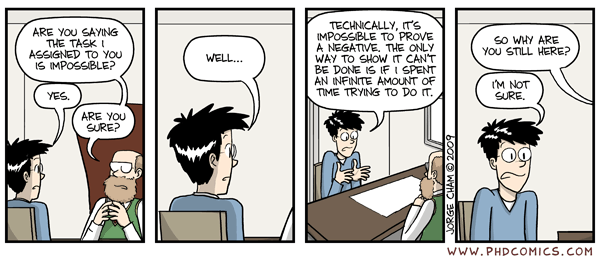
Subject: Burden of Proof


I did some research to find what others say "proving the negative" means. Doing that research showed me that the argument is really about "Burden of Proof." For example, I found a reference to "Russell's Teapot" which says,
Russell's teapot, sometimes called the celestial teapot or cosmic teapot, is an analogy first coined by the philosopher Bertrand Russell (1872–1970) to illustrate that the philosophic burden of proof lies upon a person making scientifically unfalsifiable claims rather than shifting the burden of proof to others, ... Russell wrote that if he claims that a teapot orbits the Sun somewhere in space between the Earth and Mars, it is nonsensical for him to expect others to believe him on the grounds that they cannot prove him wrong.
Another source:
The burden of proof is always on the claim that X exists rather than on the claim that X does not exist.
Another source that may be easier to understand says:
A negative proof is a logical fallacy which takes the structure of:

X is true because there is no proof that X is false.
Another good source says:
The negative proof fallacy is where one assumes something is true if it cannot be proven false. It can also happen when one assumes that something is false if it cannot be proven true.

An infinite amount of silly statements might be declared and be completely unprovable, hence we cannot assume validity in the face of unprovability. This is what is known as burden of proof.
As anyone can see, that kind of argument is not really about proving someone wrong.  It has to do with claiming something is true because those who disagree cannot prove it to be false.

Here's an example of how one Anthrax Truther might argue:
I know that an American-based supporter of al Qaeda was behind the anthrax attacks because it cannot be proved that there was no al Qaeda supporter behind the anthrax attacks.  If you claim that all the evidence proves that Dr. Bruce Ivins was the anthrax mailer, all that means is that Ivins was an al Qaeda supporter, if you cannot prove he wasn't.
Here's an example of how another Anthrax Truther might argue:
I know that Dick Cheney was behind the anthrax attacks because no one has proved that he was NOT behind the attacks.
The burden on the proof MUST be on the person making the claim, not on the person who disputes the claim.

Ed

Wednesday, March 6, 2013

Subject: Circumstantial Evidence

There's been a great deal of debate on this blog and elsewhere about the evidence against Dr. Bruce Ivins in the anthrax letter case.  Anthrax Truthers endlessly argue that if an item of evidence by itself does not prove Ivins was the anthrax killer, then it's not admissible evidence. They'll examine item by item and say, "This doesn't prove Ivins was guilty."

No matter how many times I point out that it is not any single item of evidence, it is the mountain of evidence that says that Ivins made the anthrax powders and mailed the letters, the argument always returns to the Anthrax Truthers pointing to a single item of evidence and saying it doesn't Ivins was guilty.

Here's the definition of "circumstantial evidence" from one on-line legal dictionary.
"circumstantial evidence n. evidence in a trial which is not directly from an eyewitness or participant and requires some reasoning to prove a fact. There is a public perception that such evidence is weak ("all they have is circumstantial evidence"), but the probable conclusion from the circumstances may be so strong that there can be little doubt as to a vital fact ("beyond a reasonable doubt" in a criminal case...)
On my web site I have two lists of evidence.  Click HERE for a list of evidence against Dr. Ivins and the counter arguments from Anthrax Truthers who claim that none of it means anything.

Here are a few of the items of circumstantial evidence from the list at the top of my web site:
  
Dr. Ivins was in charge of the RMR-1029 flask containing the "mother" spores which produced the attack anthrax "daughter" spores.  He was in charge of "the murder weapon."
Dr. Ivins tried to destroy "smoking gun" evidence that he had encoded a hidden message inside the media letters, but the evidence was recovered and clearly points to Dr. Ivins as the anthrax mailer. 
Dr. Ivins had worked with Bacillus anthracis for over 20 years and had all the necessary expertise and equipment to prepare the spores in the anthrax letters.  He could routinely make a trillion spores a week.
Dr. Ivins worked alone and unsupervised in his lab for long hours at night and on weekends during the time the attack anthrax would have been prepared.

Dr. Ivins had no scientific reason or verifiable explanation for working those hours or at those times, and working such hours was not usual for him.

In December of 2001, Dr. Ivins secretly swabbed and bleached more than 20 areas in his lab, destroying possible evidence.   In April of 2002, he did it again.  Both cleanings were unauthorized and against protocol.  His explanations for doing it were contradictory to his actions.
Investigators examined another flask of Ames anthrax spores created by Dr. Ivins and found that a percentage of the spores in flask RMR-1030 contained silicon just like what was in the attack spores.
Dr. Ivins had multiple motives for sending the anthrax letters.

Dr. Ivins tried various ways to mislead investigators when they started to suspect him.
Dr. Ivins had no verifiable alibi for the times when he could have driven to New Jersey to mail the letters.
Here's more information about "Circumstantial Evidence":
Circumstantial evidence is evidence in which an inference is required to connect it to a conclusion of fact, like a fingerprint at the scene of a crime. By contrast, direct evidence supports the truth of an assertion directly—i.e., without need for any additional evidence or the intervening inference.
On its own, it is the nature of circumstantial evidence for more than one explanation to still be possible. Inference from one piece of circumstantial evidence may not guarantee accuracy. Circumstantial evidence usually accumulates into a collection, so that the pieces then become corroborating evidence. Together, they may more strongly support one particular inference over another. An explanation involving circumstantial evidence becomes more valid as proof of a fact when the alternative explanations have been ruled out.
Circumstantial evidence allows a trier of fact to deduce a fact exists.  In criminal law, the inference is made by the trier of facts in order to support the truth of assertion (of guilt or absence of guilt).
And a definition from another on-line dictionary:
Circumstantial Evidence: Evidence not bearing directly on the fact in dispute but on various attendant circumstances from which the judge or jury might infer the occurrence of the fact in dispute. 
Ed

Sunday, March 3, 2013

Mar. 3 - Mar. 9, 2013 Discussions

The comment I wrote for my web site for Sunday, March 3, was mostly about last week's discussions on this blog.  It's about how - even if you can't get a True Believer or conspiracy theorist to agree about anything - you can learn something yourself about the subjects under discussion by doing research and by looking for the best words and examples to use in the debate.  That's a great help if you're thinking of writing another book.

I'm thinking about writing another book.  Unfortunately, all I have so far is a basic idea and a possible title:

Last week's discussions ended with a debate over what can be entered into evidence as being "relevant" and what cannot be entered into evidence because it is "irrelevant."  The example being debated was the fact that the FBI didn't find (or couldn't prove they found) the copy machine that was used to produce the anthrax letters.  R. Rowley argued that the fact that they couldn't find the copy machine is "relevant" evidence of something.  I argued that the fact they couldn't find the copy machine not evidence of anything relevant.  It's no different than questioning someone who knows nothing and has nothing important to say.  Why put such a person on the stand?

However, the copier machine question seems like a question that can easily be resolved by checking with published sources or by asking some experts.  But, before doing that, we'd have to decide and agree on what the question is.  And, I fear that getting an agreement on a question may be as difficult as getting an agreement on an answer.  True Believers always want to phrase questions so that the only possible answer is the answer they want, even if the question no longer has anything to do with the issue that is being argued.  They'll change a question about the law into a question about what is "right" or what "most people believe."

We also did not finish discussing the difference between "proving the negative" and proving someone is wrong.  That looks like something that can be easily explained and equally easily researched, but that doesn't mean it will be easy to get an agreement.        

The big question seems to be: How do you convince a True Believer who believes something that no one else in the world believes that he could be be wrong. 

Ed

Sunday, February 24, 2013

Feb. 24 - Mar. 2, 2013 Discussions

This week's Sunday comment on my web site was entirely about the introduction to Professor Lance deHaven Smith's upcoming book "Conspiracy Theory in America."

I found Professor Smith's beliefs to be so bizarre that I had to read and re-read the introduction at least a half dozen times.  I even made a copy of it for myself, so I could highlight in red his most unbelievable beliefs.  Nearly every paragraph seems to argue something that I see as totally crazy.

Professor Smith's primary belief seems to be that it is the duty of every American to be suspicious of everything the government does, and to call for investigations of everything that seems suspicious.  And, anyone who disagree is UN-American.  He appears to argue that suspicions alone are enough to start an investigation of a government official, and, since there is no way to prove a politician is NOT corrupt, every "investigation" must therefore either find proof of corruption or be deemed a failure because the investigators obviously didn't look in the right places or look hard enough.  Or maybe the investigators joined the conspiracy.    

Professor Smith somehow believes that "the United States was founded on a conspiracy theory."  He claims the Declaration of Independence argues that King George was conspiring against the people of America.  Reading the Declaration of Independence, however, clearly shows that it presents a long list of evidence proving that King George was acting like a tyrant.  No conspiracy.  Just a list of facts showing injustices ordered and directed by the King.

The craziest part of Professor Smith's theory may be his belief that people who did as he suggests are the kind of villains he wants stopped.  Nixon and his aids suspected the Democrats of doing things that were illegal, so Nixon's aides set out to find evidence of it.  They committed crimes during their search, resulting in the Watergate scandal.  Bush-Cheney suspected Saddam Hussein of having connections to al Qaeda and being somehow responsible for 9/11, so they set out to find evidence of it.  That led to an unnecessary war and the finding NO evidence of a connection between Hussein and 9/11 or al Qaeda.

The Introduction to Professor Smith's book also includes some truly crazy beliefs about the anthrax attacks of 2001.  Professor Smith argues that as soon as investigators found that USAMRIID may have had a connection to the anthrax attacks, the investigators should have assumed that the U.S. Military may also have been behind 9/11.  Why?  Because Professor Smith has a crazy belief that governments are the same as individual criminals.  If individual criminals can be caught by looking for patterns in their crimes, then investigators should look for the same thing when they suspect governments of crimes. Professor Smith wrote:
It is routine police protocol to look for patterns in burglaries, bank robberies, car thefts, and other crimes, and to use any patterns that are discovered as clues to the perpetrators’ identity and the vulnerabilities to crime that are being exploited. This method of crime analysis is shown repeatedly in crime shows on TV. It is Criminology 101. There is no excuse for most Americans, much less criminal investigators, journalists, and other professionals, to fail to apply this method to assassinations, election fiascos, defense failures, and other suspicious events that shape national political priorities.  
Evidently Professor Smith cannot see any difference between administrations or eras.  He feels that, if President Nixon helped cover up an illegal break-in at the Watergate Hotel, it should be assumed that President Obama is currently helping cover up a U.S. Government plot that Professor Smith believes was behind 9/11 and the anthrax attacks of 2001.

Professor Smith's book won't actually be published until April.  When it is, I hope there will be some discussion about it.  I hope it won't just be ignored the way the recent conspiracy theory paper by Professor Martin Hugh-Jones, Dr. Barbara Hatch Rosenberg and Dr. Stuart Jacobsen was ignored.  I think Professor Smith's book could be a very fascinating look into the workings of the mind of a true conspiracy theorist.

Meanwhile, on this forum last week, I had a long discussion with R. Rowley who seems to truly believe that he knows who sent the anthrax letters, and it wasn't Dr. Bruce Ivins.  Mr. Rowley doesn't think the FBI "bungled" the investigation, he just thinks they didn't understand evidence, they used wrong investigative techniques, they used invalid reasoning, and they came up with the wrong suspect.  Mr. Rowley plans to write a book in which he'll show why the FBI was wrong, and he'll explain his theory about the art of linguistics and how it shows someone other than Dr. Ivins was the culprit.  But, when you get to the end of Mr. Rowley's book, you'll find he doesn't name the real culprit.  You just have to trust that he's right.  That seems like a practical joke to me, but it appears Mr. Rowley has high hopes for the book.  

Ed

Sunday, February 17, 2013

Feb. 17 - Feb. 23, 2013 Discussions

My comment for Sunday, Feb. 17, was mostly about a paper titled "Conspiracy Theories" by Cass R. Sunstein and Adrian Vermeule from the University of Chicago and Harvard Law Schools.

The article uses a lot of "highfalutin" words to make many of the same observations I've been making about conspiracy theorists and True Believers for 11 years.

What I call "arguing beliefs against facts," they call "crippled epistemology." 

What I call "illogical reasoning," they call "identifiable cognitive blunders."


And Sunstein and Vermeule use the term "degenerating research program," which just means using a bad hypothesis that requires that supporters constantly have to rationalize and explain away more and more evidence which shows their hypothesis is wrong. (A "progressive research program" is an hypothesis which new evidence tends to confirm.) 

However, while I agree with Sunstein and Vermeule on many observations, I tend to disagree with them on others.  Clearly they include among the "conspiracy theorists" many people who just think the government is incompetent, and that's why the government's "official explanation" doesn't explain what really happened.  Such people have no conspiracy theory, therefore they cannot be labeled as "conspiracy theorists."  They are "True Believers" who have the unshakable belief that they know "the truth" and the rest of the world doesn't. 

Sunstein and Vermeule also seem to fail to recognize that each Truther (conspiracy theorists and True Believers) has his own unique theory, whether they be Anthrax Truthers, 9/11 Truthers, Moon Landing Truthers, Climate Change Truthers or any other kind of Truther.  The only thing that makes them a "group" is the fact that they all believe the official version is wrong.  They seem to either believe everyone will see that they are right if they can just convince the world that the government is wrong, or they believe that the first goal is to convince everyone that the government is wrong, and then they can all sort out who is right.

Furthermore, Anthrax Truthers often think that 9/11 Truthers are nuts, and vice versa.  9/11 Truthers often think that Moon Landing Truthers are nuts, and vice versa.  Climate Change Truthers often think that Anthrax Truthers are nuts, and vice versa.  So, there's not only disagreement within each group of Truthers, they also often disagree with each other on a group level.

Sunstein and Vermeule fail to make that a key point.  I see it as THE key point.

My next chore is to learn more about epistemology.  As I understand it,
 
False propositions cannot be known.  Therefore, knowledge requires truth.  Something has to be true before it can be known.

However, if you don't believe a thing, you cannot know that thing.  Therefore knowledge also requires belief.

But, belief is not knowledge.  Therefore, knowledge also requires justification.

Justification assures that a belief is not just a wild guess.

So, truth, belief and justification are together necessary to have knowledge.
    
But how do you convince True Believers that the false propositions they believe in so thoroughly are false because they are contradicted by an abundance of verifiable evidence, when True Believers seem to believe that no evidence is really evidence unless by itself it is undeniable proof?  And, they can provide no such evidence (or even any meaningful evidence) to verify their own beliefs.

Ed

Sunday, February 10, 2013

Feb. 10 - Feb. 16, 2013 Discussions

It occurred to me this morning (and I wrote about it in my Sunday comment on my web site) that all the "Truthers" out there arguing against what the facts say about the anthrax attacks of 2001 (and the 9/11 attacks, and the landings on the moon, and the causes of climate change, and the connection between HIV and AIDS, and the links between cancer and smoking, and the official versions of many other subjects) are not really arguing about what they believe.  They are arguing about what they cannot believe.  Instead of being called "conspiracy theorists" and "True Believers," they might more accurately and properly be called "Cannot Believers."  Here's part of what I wrote in my Sunday comment:

Some people simply cannot believe that a lone gunman could single-handedly concoct a plot and fire a rifle with such accuracy to kill an American President in a moving vehicle.

Some people simply cannot believe that a single airliner striking a modern skyscraper could cause the entire building to collapse like a house of cards.

Some people simply cannot believe that it's just a coincidence that there were mass shootings using assault weapons at the time when the government wanted to crack down on ownership of such weapons.

Some people simply cannot believe that it is possible for humans to travel all the way to the moon and back and live to tell about it.

Some people simply cannot believe that it is possible for mere humans to affect the entire atmosphere of a planet the size of the earth.

Some people simply cannot believe that smoking causes cancer when there are so many people who smoked all their lives and never got cancer.

Some people simply cannot believe that a virus would mysteriously appear to kill mostly homosexuals when it is clear there are so many people opposed to homosexuality.

Some people simply cannot believe that the anthrax attack could come so soon after the 9/11 attacks without the same people being responsible for both attacks.

Some people simply cannot believe it was just a coincidence that there was a biological weapons terrorist attack so soon after America trashed the Biological and Toxic Weapons Convention because it didn't address attacks from terrorist organizations.

Some people simply cannot believe that a lone individual can create a super-sophisticated anthrax powder with the properties exhibited by the senate anthrax powders.

Some people simply cannot believe that someone they knew, particularly a socially inept person like Bruce Ivins, could commit the crime for which he was accused.

And, because these individuals cannot personally believe these things, they develop personal theories to account for what must have "really happened."  I.e., either some people in the government must have conspired to make it appear that the impossible happened, or the people in charge of investigating such things are so incompetent that they actually believe the impossible happened and don't see how impossible it really is.
  

So, the conspiracy theories are NOT what the conspiracy theorists believe, but what they developed because of what they CANNOT believe.

That's a very different ball game.  

It suggests that additional information CAN have an impact on them.  It says they are arguing from ignorance, thus some facts just might make a difference.

It's something worth thinking more about.

Ed

Sunday, February 3, 2013

Feb. 3 - Feb. 9, 2013 Discussions

The bulk of my comment for Sunday February 3rd is about a new article from the Anthrax Truther Trio of Martin Hugh-Jones, Barbara Hatch Rosenberg and Stuart Jacobsen.  The article was printed in the Journal of Bioterrorism & Biodefense and is titled "Evidence for the Source of the 2001 Attack Anthrax."  I found it to be a masterpiece of obfuscation where they write one thing and imply another.  Plus, it is an excellent example of using junk science to challenge real science.

I don't see any reason to repeat the entire comment here, but I suppose I should outline some key points:

1.  They seem to imply that Dugway was the source of the attack powders because Dugway weaponized spores with silicon in the past, and some spores also contained tin, which was found in trace amounts in the attack spores.  They ignore the fact that water isotope ratios found in the attack spores indicate that the spores were made in and East Coast lab and that Utah is one area that does not have those isotope ratios.   

2.  They repeatedly imply that anthrax spores microencapsulated with a silicon compound would look like the spores used in the attacks.  But, their references show just the opposite.  One reference even has an illustration which shows that microencapsulated spores would look nothing like what was found in the anthrax letters.  Here's that illustration:
This form of encapsulation clearly puts the coating on the outside of the exosporium, yet the Truther Trio repeatedly argues that it would be inside the spore coat and under the exosporium.  This form of encapsulation LOOKS very much like a different form of "encapsulation" which Dugway routinely uses and has used since the 1950's in tests.  On page 176 of my new book I have a photo of an "encapsulated" spore created by Dugway:
 3. The Truther Trio repeatedly uses gross data to argue that the silicon and tin amounts in the attack spores indicate "microencapsulation" and/or "weaponization."  In reality, gross data means nothing, since their numbers are mostly from the New York Post powder, and that powder was non-homogenous.  Dr. Ivins washed the spores out of the plates, and then he centrifuged the results to get rid of the excess water before he air dried the spores.  Centrifuging results in concentrating certain elements or materials in different layers within the centrifuge tube.  Thus, when the dried material is broken up, you'll have particles that are high in one element while another particle may not have that element at all.  Assuming that the entire powder is like what one sample indicates is pure junk science.  

I could go on and on.  I had to write most of the comment this morning, trying to get it done by 10 or 10:30 a.m., when I normally post my Sunday comment.  As a result, it contains a lot of repetition, and not everything is as well stated or well researched as I would like.  During the course of the day, I'll be going back over it to make improvements.

I'm also looking forward to what others might have to say and write about this article.  Will the New York Times mention it on their first page as they did with the previous nonsense from the same Truther Trio?  Will other scientists shoot it down?  Or is it old news and not worth bothering with?  It seems almost certain that the McClatchy Newspaper chain will jump on it as "proof" of something.

Whatever is written, it should give me something to comment about.  It's been a long time since there was any "news" about the anthrax attacks of 2001.

Ed